
কনটেন্টটি শেষ হাল-নাগাদ করা হয়েছে: বৃহস্পতিবার, ১৫ অক্টোবর, ২০২৬ এ ০৯:৪৭ AM
test
কন্টেন্ট: পাতা
Citizen Innovation
‘Citizen Innovation’ is a strategic initiative designed to promote meaningful citizen engagement in government processes. It aims to strengthen democratic governance by ensuring that public services, policies, and decision-making processes are shaped by the voices and needs of the people they serve.
Vision and Mission
Vision:
To institutionalize citizen-driven innovation in public policy and service delivery across Bangladesh.
Mission:
To co-create citizen-centered solutions that improve government services and to facilitate meaningful citizen participation in public policy and decision-making.
Core Objectives
Enhancing Citizen-Centric Service Delivery: Promote citizen-led innovations in the design and delivery of public services to ensure maximum accessibility, efficiency, and user-friendliness.
Strengthening Participatory Governance: Facilitate active citizen involvement in the formulation of government plans, budgets, legislation, policies, and strategic documents.
Creating Inclusive Dialogue Mechanisms: Establish accessible and inclusive platforms for citizens to engage in dialogue with government institutions on a wide range of public issues.
Major Work Areas
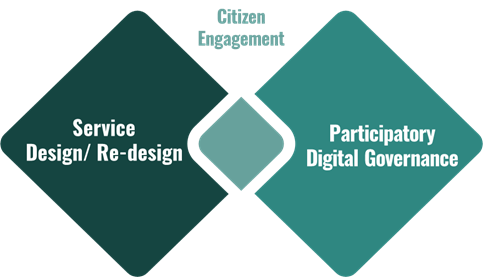
A. Public Service Design/ Re-design
To create truly citizen-friendly services, it is imperative to integrate service recipients directly into the service design process. Leading nations—including South Korea, the United States, the United Kingdom, and Estonia—are already leveraging this approach to co-create more effective and inclusive public services.
When citizens are actively involved in the design phase, services become more accessible, better utilized, and significantly improved in quality. Moreover, this participatory model accelerates progress toward the Sustainable Development Goals (SDGs).
B. Participatory Digital Governance
e-Participation platform is a cornerstone of the Citizen Innovation initiative, designed to foster inclusive, transparent, and responsive governance. It will enable citizens to engage directly with government institutions and meaningfully contribute to public decision-making processes digitally.
Institutionalizing e-Participation will enable citizens to:
Express their opinions and preferences on national and local budgets, development priorities, and annual plans;
Provide feedback on proposed government projects and suggest alternative approaches;
- Actively participate in the drafting and review of public policies, laws, and strategic frameworks.
Our Approach
A. Understand Your Customer (UYC) Study to Design/ Re-design Public Services
Understand Your Customer (UYC) Study Process:
The UYC study is a structured initiative to assess citizen needs and challenges in accessing government digital services. It includes the following key steps:
Identifying target user groups;
Designing tailored questionnaires to extract relevant insights;
Gathering feedback from diverse demographic segments;
Engaging subject-matter experts for validation and deeper analysis;
Categorizing findings and presenting them in collaborative workshops with government agencies;
Delivering a final comprehensive report containing actionable recommendations.
B. Citizens’ Direct Participatory System (E-Participation)
By creating structured avenues for civic engagement, the system will help institutionalize participatory governance and ensure that public decisions are informed by diverse citizen perspectives.
C. Standards and guidance
Citizen Innovation converts what it learns into instruments that government institutions can apply independently. These are grouped by what they help an officer do.
Designing services
Workbook for Citizen-Friendly Public Service Design
The purpose of this workbook is to guide government institutions in making public services more citizen-friendly through a structured, inclusive, and collaborative approach. It provides guidance on co-designing Understand Your Customer (UYC) studies with service providers and service recipients so that services are shaped by real user needs and experiences. The workbook also supports institutions in using tools such as Customer Journeys, Customer Personas, and Accessibility Audits to identify user challenges and barriers, particularly those faced by persons with disabilities in accessing digital public services.
By supporting institutions to design services that are simple and easy to use, the workbook aims not only to improve citizens’ experience but also to make service delivery more efficient for government institutions by reducing the need for training and support. Citizen-friendly services also encourage higher adoption, helping ensure that public policies and programs reach their intended beneficiaries and achieve their intended outcomes.
Attachment: Workbook for Citizen-Friendly Public Service Design
Digital Empathy Manual
The Digital Empathy Manual is being redesigned as a practical tool to make public services more demand-driven and citizen-friendly by strengthening empathy among service providers as well as the service designers. The redesigned manual will provide practical approaches, tools, and exercises to help them better understand citizens’ needs, experiences, challenges, and expectations and translate these insights into service improvements. By embedding citizens’ perspectives into service design and delivery, the manual will support the development of services that are simpler, more accessible, inclusive, responsive, and better aligned with citizens’ needs.
Measuring performance
Local Level Ranking on Citizen-Friendly Public Services
The Local Level Ranking on Citizen-Friendly Public Services aims to encourage government offices to make public services more citizen-friendly, inclusive, accessible, and responsive. The ranking will assess offices across a range of dimensions of citizen-centric service delivery, including service quality, citizen engagement and satisfaction, inclusiveness, accessibility, and e-participation. A framework for the ranking is currently being developed, with a focus on identifying priority areas for improvement and enabling government organizations to undertake targeted actions while promoting accountability, continuous improvement, and peer learning. The initiative will also help strengthen Bangladesh’s performance on relevant global benchmarks, including the DARE Index by G3ICT, the UN E-Government Development Index (EGDI), and the World Bank’s GovTech Maturity Index (GTMI). The ranking will be implemented by Agency to Innovate (a2i) with support from UNDP, under the guidance of the ICT Division and Cabinet Division, with the Cabinet Division supervising the overall ranking process.
Enabling participation
e-Participation Strategy
The e-participation strategy is a structured plan for using digital technologies to strengthen citizen involvement in public governance and decision-making. It was created to establish a shared vision, priorities, responsibilities, and actions for delivering inclusive, transparent, and effective digital participation. The strategy is primarily intended for government leaders, public institutions, policymakers, technology teams, civil-society organizations, and development partners responsible for planning, implementing, or supporting e-participation initiatives.
e-Participation Guideline
The e-participation guideline is a practical framework for using digital tools to involve citizens in public decision-making, consultations, and service improvement. It was created to make online participation inclusive, transparent, secure, and effective while ensuring that public feedback is meaningfully considered. The guideline is primarily intended for government institutions, public officials, digital-platform managers, and civil-society organizations that design or manage e-participation initiatives. It also helps citizens understand how they can engage responsibly in digital public processes.
Progress at a glance
Results and stories
From citizen feedback to national platforms
Recommendations produced through UYC studies have changed how citizens experience some of Bangladesh's most widely used public services.
myGov and the 333 Helpline now listen back. Both platforms introduced citizen feedback and rating systems following UYC study recommendations, turning one-way service delivery into a channel that carries information in both directions.
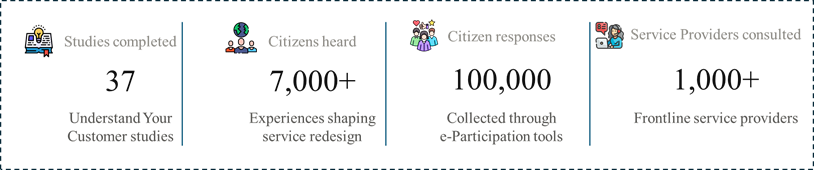
The National Portal opened a route into decision-making. e-Participation tools launched on the National Portal have collected approximately 100,000 citizen responses on public matters, giving government institutions a standing source of citizen evidence.
Passport services made their commitments legible. The Citizens Charter was updated so that service information is easier for citizens to find and understand - a direct response to the finding that incomplete information was pushing citizens towards intermediaries.
Citizen engagement became a national requirement. The demonstrated effectiveness of UYC data and customer journey mapping led to citizen engagement being incorporated into the Service Simplification Manual 2026. What began as a method is now part of how government simplifies services.
Contribution to global commitments
These works advance SDG 16 on effective, accountable and inclusive institutions and responsive, participatory decision-making; SDG 10 on equitable access and reduced disparity for underserved groups; and SDG 17 on multi-stakeholder collaboration and scalable partnership.
They also strengthen Bangladesh's position across the UN E-Government Development Index, the UN E-Participation Index, the GovTech Maturity Index and the Global Innovation Index.
Who We Work With
Connecting government and society
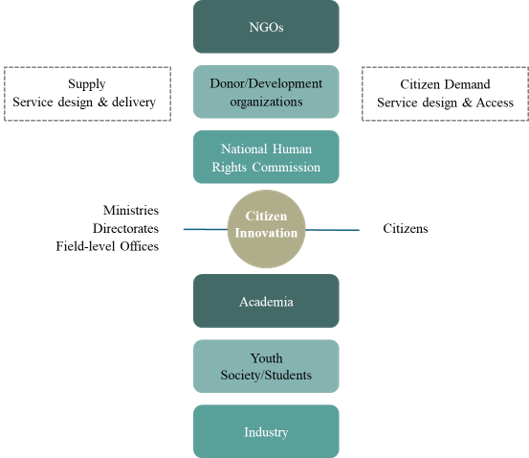
Citizen Innovation connects public-service providers with the citizens who use their services, bringing groups together to share evidence, examine problems and develop better solutions.
Government: ICT Division, Cabinet Division, Ministries, Directorates and field-level offices.
Development partners: UNDP, providing technical and financial support.
Research organisations: Bangladesh Bureau of Statistics, BRAC Institute of Governance and Development, HorizonHub, Cleinsights, Development Research Initiative, and so on.
Academia: Dhaka University, North South University, Jahangirnagar University, Sunamganj Science and Technology University, Mawlana Bhashani Science and Technology University, Bangladesh University of Engineering and Technology, Begum Rokeya University, National University, etc.
Civil society and citizens: Citizens and citizen groups, non-governmental organisations, the National Human Rights Commission, youth and student organisations, and industry.
Knowledge Donors: Quicksand, UN Belarus, UNDP Accelerator Labs, BIGD, Unilever Bangladesh, Go Vocal (Belgium), and so on.
Work with us
Let us build better public services with citizens
Citizen-centred government requires citizens, public institutions, civil society, researchers, development partners and industry to work together. Citizen Innovation welcomes opportunities to share knowledge, study citizen needs, improve public services and develop inclusive ways for people to participate.
Areas of collaboration include:
Citizen research and service improvement studies
Public-service design and process simplification
Participatory governance and civic technology
Inclusive dialogue and stakeholder engagement
Training, research and knowledge sharing
Policy formulation